Orange Bags, Same Plastic Pipeline: Why Tucson Should Rethink Hefty ReNew
Tucson prides itself on environmental stewardship. But when it comes to plastic waste, good branding does not always equal good policy.
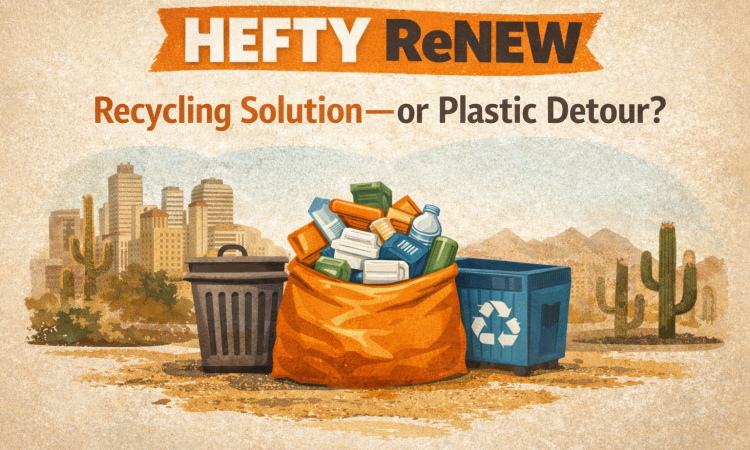
The Hefty ReNew program — promoted locally by Tucson Environmental Services in partnership with Reynolds Consumer Products and Dow Chemical Company — asks residents to buy special orange bags, fill them with hard-to-recycle plastics (films, foam, flexible packaging), and drop them off for collection.
The collected plastics are then:
- Repurposed into products like plastic blocks, lumber or other building materials
- Processed through high-heat systems such as pyrolysis or gasification
- Burned in cement kilns as a substitute for coal to create energy
It is marketed as an innovative recycling solution. But a closer look suggests it may be steering Tucson away from real sustainability.
1. It Focuses on Disposal — Not Prevention
Hefty ReNew manages plastic after it has already been produced, sold, and used. It does not reduce the amount of single-use plastic entering our community in the first place.
When consumers believe something is “recyclable,” they often feel less pressure to reduce consumption. Programs like this can unintentionally reinforce throwaway habits instead of challenging them.
It’s also important to ask who designed the program. Reynolds sells disposable plastic products. Dow is one of the world’s largest plastic resin manufacturers. Their core business depends on continued plastic production. That raises a fundamental question: can a program created by plastic producers truly solve the plastic problem?
2. It Reinforces Fossil Fuel Dependence
Nearly all single-use plastics are made from fossil fuels. As demand for oil and gas for transportation and electricity faces long-term decline, petrochemicals and plastics have become major growth markets for fossil fuel companies.
Global plastic production has doubled since 2000 and is projected to continue rising. Diverting plastic to alternative uses does not reduce the drilling, fracking, refining, and petrochemical expansion driving climate change. It simply reshuffles where the plastic ends up.
If we are serious about climate goals, we cannot ignore plastic’s fossil fuel foundation.
3. It Ignores Plastic’s Full Lifecycle Impacts
Plastic pollution is more than a waste or litter problem.
Environmental and health harms occur:
- During oil and gas extraction, including methane leaks and toxic releases
- During refining and plastic feedstock production, which are energy-intensive and emissions-heavy
- In frontline communities exposed to hazardous air pollutants
Managing plastic at the waste stage does not address these upstream climate and toxic burdens. A truly sustainable solution must consider the full lifecycle of plastic — from wellhead to disposal.
4. Downcycling Is Not Circular
Much of the material collected through Hefty ReNew is repurposed into building products rather than recycled back into equivalent packaging.
This process, often called “downcycling,” does not create a closed loop. It requires new virgin plastic to replace the original disposable products. That means more fossil fuel extraction, not less.
A real circular economy keeps materials in the same product system, reducing the need for new raw inputs. Hefty ReNew does not meet that standard.
5. High-Heat Processing Is Energy-Intensive and Polluting
Some collected plastics may be sent to high-heat facilities such as pyrolysis plants. These systems require substantial energy and can emit hazardous pollutants, including dioxins and polycyclic aromatic hydrocarbons. Most of the output becomes fuel, not new resin, with less than a third ever returning as plastic.
Burning plastic in cement kilns as a coal substitute is not a climate solution either. It simply swaps one fossil fuel for another and can emit toxic pollutants, including heavy metals and persistent organic compounds.
What Real Solutions Look Like
Recycling alone cannot keep pace with rising plastic production. If Tucson wants to lead on sustainability, we need to prioritize prevention.
That means:
- Promoting the reduction of single-use plastics among residents whenever feasible
- Scaling up reuse and refill systems at grocery stores and other retailers
- Supporting restaurants and businesses in adopting reusable serviceware
- Implementing “Skip the Stuff” practices at restaurants and other dining establishments
- Using municipal purchasing power to eliminate disposable plastics
- Advocating for policies that hold producers accountable
The Bottom Line
Hefty ReNew may divert some material from the landfill. But it does not reduce plastic production, fossil fuel dependence, or the climate and health harms embedded in plastic’s lifecycle.
If Tucson is serious about sustainability, we must shift our focus from managing plastic waste to preventing it. Real circular solutions reduce material use, expand reuse systems, and phase down unnecessary single-use plastics — rather than repackaging the status quo in orange bags.
