Tucson’s Los Reales Landfill sits quietly on the southeast side, rarely noticed by most residents. Yet, what happens there has profound consequences for our climate, and it’s a place where Tucson can lead by example. As we grapple with the realities of climate change, tackling methane emissions from landfills is one of the fastest ways we can make a real difference.
Why Methane Matters
Landfills are among the largest sources of methane pollution in the United States. Methane is a greenhouse gas that’s many times more potent than carbon dioxide in the short term. Because methane breaks down quickly, reducing its emissions is one of the most effective ways to slow global warming in the coming decades.
At Los Reales, methane is produced as organic materials—food scraps, paper, and yard debris—decompose underground in low-oxygen conditions. This process continues for years after waste is buried, with much of the gas escaping unnoticed.
What We’re Doing—and What We’re Missing
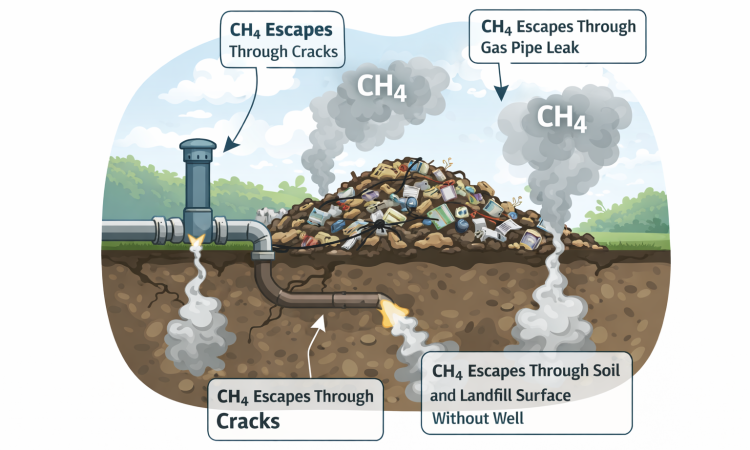
Los Reales has a gas collection system that captures methane and routes it to a flare, converting it to carbon dioxide and reducing its climate impact. This is a critical step, but here’s the problem: it doesn’t capture everything. Methane escapes through cracks in the landfill surface, gaps in soil cover, areas without gas collection wells, and leaks in pipes or infrastructure. These “fugitive emissions” are often invisible,
In fact, recent studies using aircraft and satellite measurements suggest landfill methane emissions may be two to three times higher than modeled estimates. That means we may not be seeing the full picture of what’s actually being released.
Lessons from Other States
The good news? Solutions exist, and many states are using them. California and Washington require regular methane monitoring across landfill surfaces. Infrared cameras and drones are deployed to detect methane plumes, and when leaks are found, operators must repair them quickly—often within weeks. Improving gas collection systems with more wells, better spacing, and earlier installation has proven to capture more methane.
These strategies are practical and effective—and Tucson can adopt them without reinventing the wheel.
Stopping Methane Before It Starts
Beyond monitoring and gas collection, the most important solution is to stop methane before it forms. That means reducing the amount of organic waste sent to landfills. Food scraps, paper, and yard waste account for a large portion of what we throw away, driving most methane emissions. When we compost or reduce food waste, we prevent methane from forming entirely.
- Expanding residential/community composting programs
- Supporting food rescue and donation efforts
- Diverting yard and wood waste
- Encouraging food waste prevention
These efforts don’t just reduce methane—they save resources and build a more sustainable community.
A Practical Path Forward
Tucson can strengthen its methane strategy at Los Reales by implementing routine methane monitoring, setting clear timelines for repairs, improving gas collection, and expanding composting and food waste diversion programs. Together, these steps form a comprehensive approach that tackles methane at every stage—from generation to release.
The Bottom Line
Tucson has a real opportunity to reduce landfill methane emissions using proven, widely available tools. This isn’t about starting from scratch. It’s about building on what’s already in place and making it work better. Effective methane control means not only capturing what we can, but finding what escapes—and preventing methane from forming in the first place. By taking these steps, Tucson can lead the way in responsible waste management and climate action.
Because effective methane control requires more than capturing what we can.
It requires finding what escapes—and preventing it from forming in the first place.
