Tucson Needs to Measure Recycling Results, Not Just Tons Collected
How well is Tucson actually doing at recycling and composting?
It should be an easy question to answer. Unfortunately, the data currently reported by Tucson Environmental Services make it difficult to tell.
The Department’s 2025 By the Numbers report provides plenty of numbers. It reports 19,974 tons of recyclables collected and processed, 1,276 tons of glass collected, 594 tons of household hazardous waste collected, and 599 tons of “food waste and Zoo Doo” collected for composting.
These numbers tell us something about the scale of the programs. But they leave out an essential piece of information: What percentage of Tucson’s waste is actually being diverted from the landfill?
Tons Collected Aren’t the Same as Performance
Consider residential recycling.
A 2022 analysis found that 24% of Los Reales Landfill waste came from Department collections. Based on approximately 170,000 tons of residential trash and roughly 20,000 tons of recyclables collected, I estimate that Tucson’s residential recycling diversion rate would be about 10.5%.
That percentage tells us much more than tonnage alone because it gives residents and policymakers a benchmark that can be tracked from year to year to determine if Tucson’s recycling program is performing well.
Is the recycling rate increasing? Is it declining? Are programs making a measurable difference?
Those are questions that tonnage alone cannot answer.
What About Food Waste?
The same problem appears with FoodCycle at Home and Tucson’s other organics-diversion efforts.
Environmental Services reports 599 tons of “food waste and Zoo Doo” collected to make compost. But it doesn’t tell residents how much of that total was residential food waste.
If food scraps represent roughly one-quarter of Tucson’s residential trash, a 170,000-ton residential waste stream would contain approximately 42,500 tons of food waste.
Even if all 599 tons reported by Environmental Services were residential food waste—which they were not—that would represent only about 1.4% of the estimated residential food-waste stream.
Participation is another key measure. Environmental Services reports 3,450 FoodCycle at Home participants, but without stating how many households are eligible, that number lacks context. Reporting participation as a percentage would give residents a much clearer picture of the program’s reach.
The Same Standard Should Apply to Plastics
Tucson should apply the same approach when evaluating newer diversion programs.
If a facility such as ByFusion’s plastic block manufacturing operation at the landfill processes 2,400 tons of plastic waste annually, saying “2,400 tons diverted” may sound impressive. But what does that number actually mean?
How much plastic waste does Tucson generate annually? How much comes from residential versus commercial sources? What percentage is captured by the program? And how much plastic continues to be landfilled?
Without those denominators, a tonnage figure tells us very little about the significance of the program.
Individuals Shouldn’t Have to Do the Math
The calculations above are estimates—and that illustrates the problem.
I shouldn’t be the one to reconstruct Tucson’s waste stream from different reports and make assumptions to determine whether recycling and composting programs are working.
Environmental Services has access to better data and should provide standardized performance measures that show long-term trends.
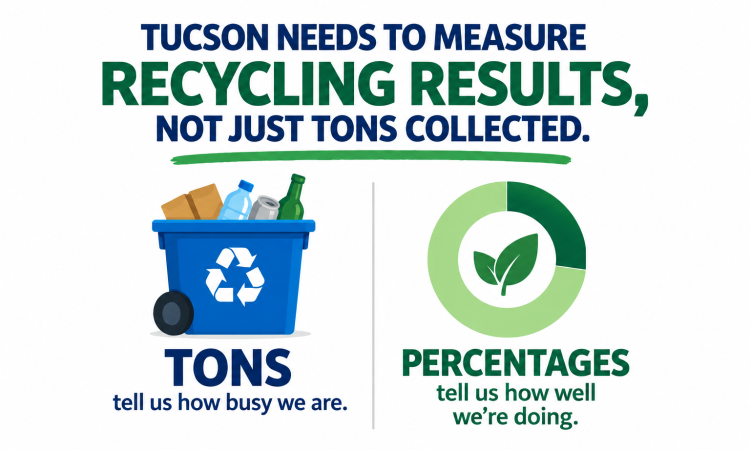
Tons collected measure activity. Diversion and capture rates measure performance.
Set Goals—and Report Progress
Better reporting also needs to be accompanied by measurable goals.
Tucson should establish a series of waste diversion targets for the next decade, with interim milestones. These should include targets for the residential recycling rate, food-waste composting, household participation, contamination reduction, and overall landfill diversion.
Better metrics can reveal where programs are succeeding, where improvement is needed, and where Tucson should focus its resources next.
Cities that take recycling and composting seriously don’t just hope for better outcomes — they set targets, track progress, identify gaps, and adjust programs accordingly. That’s important—because without performance targets, even well-intentioned programs can drift.
If Tucson is serious about reducing landfill disposal and moving toward a more sustainable waste system, we need to know whether its recycling and composting programs are capturing a larger share of the waste stream each year.
Don’t just tell us how many tons Tucson collected. Tell us what percentage we diverted—and whether we’re making progress.
