
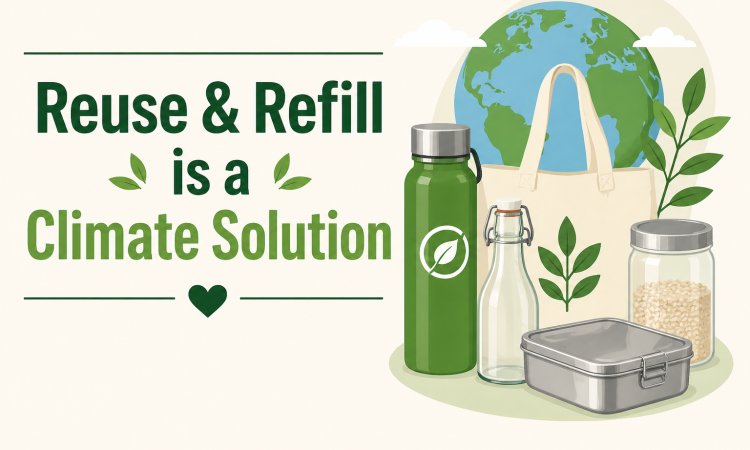
Reuse and Refill: The Climate Solution Hiding in Plain Sight
When it comes to reducing climate pollution, recycling often gets the spotlight. But if we’re serious about cutting greenhouse gas emissions, we need to shift our focus upstream—toward reuse and refill systems. While recycling plays a role, it simply cannot compete with the climate benefits of using less in the first place.
Recycling Still Comes with a Carbon Cost
Recycling is frequently framed as a clean, circular solution. But in practice, materials must be collected, transported, sorted, cleaned, and reprocessed—each step requiring energy, often from fossil fuels. For plastics in particular, recycling rarely delivers true circularity. Most plastic is downcycled into lower-value products, and new plastic production continues to rely heavily on fossil fuel extraction and refining.
Even in best-case scenarios, recycling reduces emissions compared to making products from virgin materials—but it does not eliminate them. And because recycling happens after a product has already been produced and used, it does nothing to avoid the substantial emissions generated during manufacturing.
Reuse and Refill Prevent Emissions Before They Start
Reuse and refill systems flip the script. Instead of managing waste after it’s created, they prevent waste—and the associated emissions—from being generated at all. A reusable container can replace dozens, hundreds, or even thousands of single-use items over its lifetime.
That means:
- Fewer raw materials extracted
- Less energy used in manufacturing
- Reduced transportation and packaging impacts
- Dramatically lower overall greenhouse gas emissions
From refillable beverage bottles to bulk food systems and reusable takeout containers, these models cut emissions at every stage of the product lifecycle.
The Climate Math Favors Reuse
The climate advantage of reuse comes down to simple math: the more times a product is reused, the lower its per-use environmental impact becomes. After just a handful of uses, many reusable systems outperform single-use alternatives—even when accounting for washing and transport.
This is especially important for plastic. Producing plastic is highly carbon-intensive, with significant emissions occurring before a product is ever used. Reuse systems reduce demand for new plastic, directly cutting these upstream emissions.
Recycling Can’t Keep Up with the Waste Stream
Despite decades of effort, recycling rates—especially for plastics—remain low. In the U.S., only a small fraction of plastic waste is actually recycled. Much of the rest is landfilled, burned, or exported.
Recycling systems are also easily overwhelmed by the sheer volume and complexity of modern packaging. Multi-layer plastics, food contamination, and constantly changing product designs make efficient recycling difficult and costly.
Reuse systems, by contrast, simplify the system. Standardized containers, deposit-return programs, and refill infrastructure can dramatically reduce waste while delivering consistent climate benefits.
Building a Low-Carbon Future Means Moving Beyond Recycling
To meaningfully address climate change, we need to prioritize solutions that deliver the biggest emissions reductions. That means shifting investment, policy, and public attention toward reuse and refill systems.
Cities and businesses can lead by:
- Supporting refill and return infrastructure
- Encouraging standardized, reusable packaging
- Adopting “Skip the Stuff” policies to reduce unnecessary foodware items
- Incentivizing reuse through grant programs, deposits, and pricing strategies
Consumers can also play a role by choosing refillable products, bringing their own containers, and supporting businesses that prioritize reuse.
