Tucson Can’t Manage What It Doesn’t Measure: Set Real Targets for Recycling and Composting
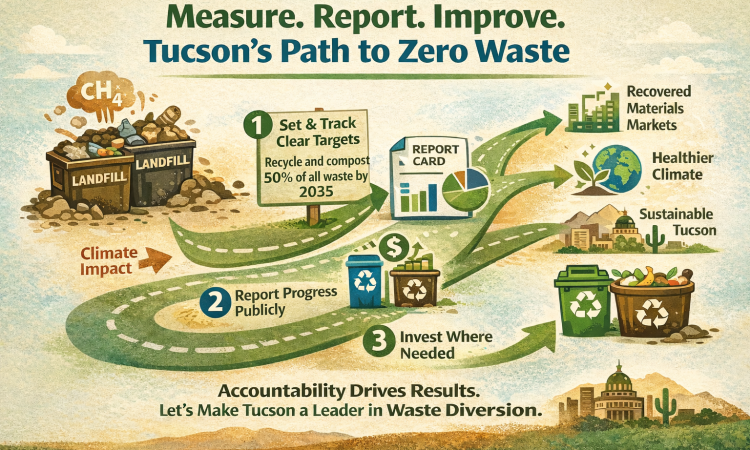
Tucson has talked about zero waste for years. But talk doesn’t divert trash—clear goals and accountability do. If the City is serious about reducing landfill waste, cutting methane emissions, and building a more sustainable local economy, the next step is straightforward: Tucson City Council should adopt measurable, time-bound performance targets for recycling and composting—and report progress publicly every year.
Right now, Tucson’s system lacks the kind of clear milestones and reporting that drive improvement. Residents are asked to recycle. Some are encouraged to compost. But the City has not established targets for how much waste should be recycled or composted, how programs should improve over time, or how success will be measured.
That’s a problem—because without performance targets, even well-intentioned programs drift.
Across the country, cities that are serious about waste reduction don’t just hope for better outcomes—they define them. They set goals like 50%, 70%, or even 90% waste diversion, paired with specific targets for recycling rates, organics collection, contamination reduction, and participation. Then they track progress, identify gaps, and adjust programs accordingly.
Tucson can—and should—do the same.
The stakes are higher than many realize. Every ton of organic waste sent to the landfill generates methane, a greenhouse gas far more potent than carbon dioxide in the near term. Improving composting and food waste diversion is one of the fastest, most cost-effective ways Tucson can reduce its climate footprint. At the same time, better recycling systems conserve resources, reduce upstream pollution, and support regional markets for recovered materials.
But neither system will improve at the pace needed without strong direction from City leadership.
Here’s what Tucson City Council should do:
First, establish defined performance targets for recycling and composting for the upcoming decade, with interim benchmarks along the way to monitor progress. This includes increasing recycling capture rates, reducing contamination in blue carts, and expanding access to composting programs. These goals should be tied to program funding and operational planning—not treated as aspirational statements.
Second, require annual public reporting.
Residents deserve to know how the system is performing. The City should publish clear, easy-to-understand reports showing recycling rates, composting volumes, contamination levels, and overall progress toward diversion goals. Transparency builds trust—and accountability.
Third, invest where the data shows it’s needed.
Performance targets aren’t just about measurement—they’re about action. If contamination is high, invest in education and monitoring. If participation is low, expand service access. If organics are still going to landfill, scale up composting infrastructure and collection programs.
Tucson doesn’t need to reinvent the wheel. Proven models exist. What’s missing is the commitment to apply them here—with urgency and accountability.
Without targets, recycling and composting programs will continue to underperform. With them, Tucson can turn good intentions into measurable results.
This is not just about waste. It’s about climate responsibility, fiscal stewardship, and building a city that takes resource conservation seriously.
