
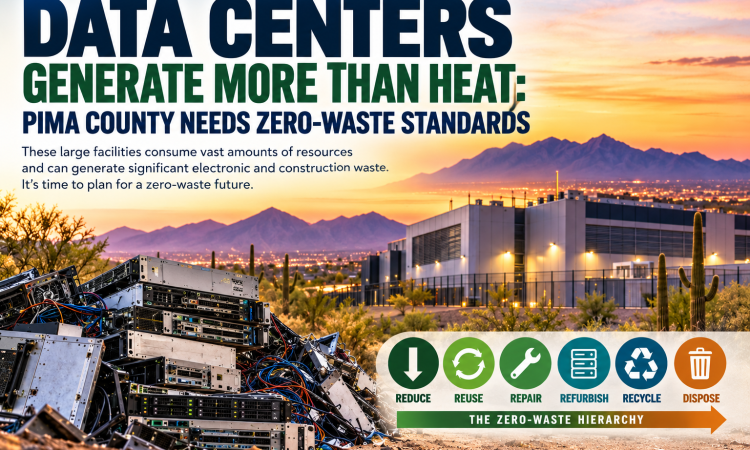
Data Centers Generate More Than Heat: Pima County Needs Zero-Waste Standards
As Pima County considers new zoning standards for large data centers, much of the attention has focused on their enormous demands for electricity and water. But there is another environmental impact that deserves attention: the substantial amounts of solid waste and discarded electronic equipment these facilities can generate throughout their operating lives.
Data centers are not simply buildings filled with computers. They are large industrial facilities that depend on a continuous supply of servers, networking equipment, batteries, cooling systems, cables, and other materials. As technology advances, much of this equipment is periodically replaced, creating a recurring stream of electronic waste.
Yet Pima County’s proposed data center zoning amendment (P26TA00003) does not adequately address waste reduction, recycling, or materials recovery.
Stop Waste Tucson has submitted public comments urging the County to incorporate enforceable waste reduction and materials management requirements into the proposed standards.
Data Centers Have a Significant Material Footprint
The environmental impacts of data centers begin long before the first server is installed.
Construction requires substantial quantities of concrete, steel, wiring, plastics, packaging, and other building materials. Once operational, facilities require ongoing maintenance and equipment replacement.
Servers and other electronic equipment contain valuable materials, including copper, aluminum, steel, and other metals. Manufacturing this equipment also requires energy, water, and raw materials. When functioning equipment is prematurely discarded, much of the value and resources invested in its production can be lost.
The rapid expansion of artificial intelligence is adding to these concerns. Increasing demand for computing power can accelerate equipment purchases and replacements, potentially generating substantial quantities of electronic waste.
The challenge is not simply how to recycle discarded equipment, but how to reduce the amount of waste generated in the first place.
Waste Reduction Should Be a Condition of Approval
Pima County is developing special zoning standards because large data centers have impacts that differ significantly from conventional commercial development.
The proposed amendment addresses issues such as energy, water, noise, backup power, and land use. Waste generation and materials management deserve similar consideration.
Stop Waste Tucson recommends requiring every large data center to prepare and implement a Waste Reduction and Materials Management Plan as a condition of approval.
The plan should address construction, daily operations, equipment replacement, and eventual decommissioning. It should establish measurable waste-reduction goals and identify how materials will be reused, repaired, refurbished, recycled, or responsibly disposed of.
Importantly, operators should also be required to report annually on the quantities of waste generated, reused, recycled, and sent to landfills.
Without measurable performance standards and public reporting, commitments to reduce waste can become little more than promises.
Recycling Alone Is Not Enough
While recycling is important, it should not be the first option for managing discarded electronic equipment.
The preferred approach follows the zero-waste hierarchy:
Reduce → Reuse → Repair → Refurbish → Recycle → Dispose
For example, extending the useful life of servers and networking equipment can reduce the demand for newly manufactured products while preserving the energy and materials already invested in their production.
Equipment that no longer meets the computing requirements of a large data center may still have value for other applications. Repair, refurbishment, resale, and reuse should therefore be considered before equipment is sent for recycling.
Recycling recovers some valuable materials, but it does not eliminate the environmental impacts associated with manufacturing replacement equipment.
A meaningful zero-waste strategy must focus on preventing waste, not simply managing it after it is generated.
Building Zero Waste Into Data Center Development
Pima County has an opportunity to establish comprehensive standards that address the environmental impacts of data centers throughout their entire life cycle.
Energy and water consumption are important concerns, but they are not the only resources that matter.
Data centers also depend on large quantities of manufactured equipment and construction materials, much of which will eventually require replacement or disposal.
Stop Waste Tucson is urging Pima County to incorporate enforceable waste reduction and materials management provisions into its proposed data center zoning amendment before the standards are adopted.
These provisions should include measurable waste-reduction goals, responsible electronic-waste management, equipment reuse and refurbishment, annual public reporting, and mandatory decommissioning plans.
If Pima County is going to accommodate large data centers, conserving materials and preventing waste should be part of the requirements from the beginning—not an afterthought once the facilities are operating.
The goal should be straightforward: data centers must manage not only the electricity and water they consume, but also the materials they use and the waste they leave behind.
