Phoenix’s Billion-Dollar Waste-to-Fuel Gamble
Turning trash into fuel may sound innovative, but it raises serious questions about climate impacts, pollution, and Phoenix’s commitment to reducing waste.
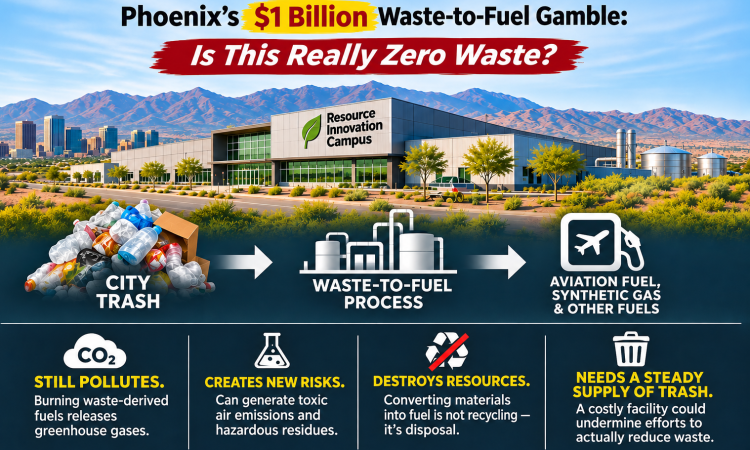
Phoenix is moving forward with a massive $1 billion Resource Innovation Campus that promises to transform municipal trash into aviation fuel, synthetic gas, and other energy products. City officials are promoting the project as an important step toward achieving their goal of zero waste by 2050.
But there is a fundamental problem with this vision: Turning trash into fuel is not zero waste. It is another way of managing discarded materials after the fact.
While recovering energy from waste may sound environmentally responsible, it does little to address the underlying causes of our growing waste crisis: excessive consumption, disposable packaging, and the continued production of single-use plastics.
Waste-to-Fuel Is Not a Circular Economy
A genuine circular economy is built around reducing waste, reusing products, and returning materials to the production cycle. Its goal is to keep valuable resources circulating in the economy for as long as possible.
Waste-to-fuel technologies take a fundamentally different approach.
Instead of preserving materials for reuse or recycling, these technologies convert discarded materials into fuels that are ultimately burned. Once consumed, those materials are permanently lost.
This distinction is especially important for plastics. Most plastics are manufactured from fossil fuel chemicals. Converting discarded plastics into aviation fuel or other energy products does not eliminate our dependence on fossil fuels. It simply changes how those fossil-derived materials are used.
Turning plastic waste into fuel is not closing the loop. It is burning the loop.
What About Climate Change and Air Pollution?
The environmental consequences of waste-to-fuel technologies deserve much greater scrutiny.
Advanced waste-conversion processes, including gasification and pyrolysis, can generate air pollutants and hazardous residues, depending on the feedstocks, technologies, and pollution controls employed.
Potential concerns include volatile organic compounds, particulate matter, acid gases, and hazardous solid residues.
Waste-derived fuels also release carbon dioxide when burned. When these fuels are produced from fossil-derived plastics, that combustion adds fossil carbon to the atmosphere.
A Billion-Dollar Incentive to Keep Producing Trash?
Perhaps the most troubling aspect of large waste-conversion projects is their potential conflict with waste prevention.
Facilities costing hundreds of millions of dollars require substantial quantities of feedstock to operate economically. Long-term contracts and financial commitments can create incentives to maintain a steady supply of waste.
But what happens if Phoenix succeeds in dramatically reducing its waste?
Would the facility have enough material to remain profitable? Could contractual obligations discourage waste reduction or divert potentially recyclable materials into fuel production?
These are legitimate questions that deserve answers before the city commits to a waste-management system that could operate for decades.
A zero-waste strategy should not depend on a continuous supply of waste to succeed.
Phoenix Should Prioritize Real Zero-Waste Solutions
Phoenix has an opportunity to become a leader in sustainable materials management. But that requires moving beyond the idea that every discarded product must be converted into another marketable commodity.
A more effective zero-waste strategy would prioritize:
- Waste prevention: Reduce unnecessary packaging and disposable products before they enter the waste stream.
- Reuse and refill systems: Support reusable food containers, packaging, and other products that replace single-use alternatives.
- Better recycling: Improve collection and processing of materials that can genuinely be recycled into new products.
- Food waste prevention and composting: Expand efforts to keep organic materials out of landfills while reducing methane emissions.
- Producer responsibility: Work with manufacturers to take greater responsibility for the packaging and products they place on the market.
- Transparent performance measures: Track actual waste reduction, material recovery, greenhouse gas emissions, and environmental impacts.
These approaches address waste at its source rather than relying on increasingly complex technologies to manage discarded materials.
Innovation Is Not Automatically Sustainability
The proposed Resource Innovation Campus may include worthwhile research, education, and materials-recovery activities. Those components deserve consideration on their merits.
But the waste-to-fuel portion of the project raises fundamental questions about environmental performance, long-term economics, and consistency with Phoenix’s zero-waste commitments.
Before proceeding, Phoenix should publicly disclose the proposed conversion technologies, anticipated waste inputs, projected emissions, and financial arrangements. Independent lifecycle assessments should compare waste-to-fuel operations with waste prevention, reuse, recycling, and composting.
The Bottom Line
Phoenix’s billion-dollar Resource Innovation Campus is being promoted as a model of sustainability. But converting discarded materials into fuels that are ultimately burned is not the same as creating a circular economy.
The measure of a successful zero-waste program is not how much trash can be converted into fuel. It is how much waste can be prevented from being generated in the first place.
Phoenix should invest in eliminating waste at the source—not building a billion-dollar industry that depends on generating it.
